
Explore how electrical control systems can improve efficiency, safety, automation, and reliability in industrial and commercial environments.
Commercial vs. Industrial Electrical Services: What's the Difference?
“Commercial electrician” and “industrial electrician” often get used interchangeably, but the two disciplines involve different equipment, different codes, and very different stakes if something goes wrong. If you’re a business or facility owner in the Wentzville or St. Charles County area trying to figure out which type of service your property actually needs, understanding the difference matters more than it might seem.
What Counts as Commercial Electrical Work
Commercial electrical services generally cover properties like offices, retail stores, restaurants, warehouses, and other business spaces where the primary electrical demand comes from lighting, HVAC systems, standard equipment, and everyday operations. Common commercial projects include:
- New construction wiring and panel installation
- Tenant improvements and remodels
- Retail and office lighting design
- Emergency and exit lighting systems
- Electrical maintenance and code-compliance upgrades
- Generator installation for backup power
Commercial work still requires strict adherence to electrical code, proper permitting, and an understanding of how a business needs to stay operational, safe, and comfortable for employees and customers. But the systems involved are generally single-phase or smaller three-phase setups built around standard business equipment.
What Counts as Industrial Electrical Work
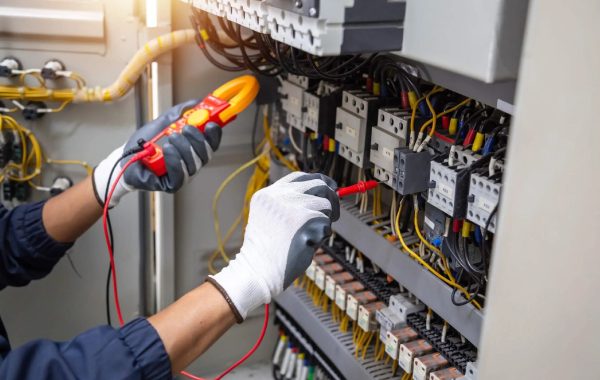
Industrial electrical services apply to manufacturing plants, processing facilities, warehouses running heavy equipment, and other environments where machinery, automation, and production uptime drive the electrical demand. Industrial projects typically involve:
- Heavy-duty three-phase power systems
- Motor controls and motor control centers (MCCs)
- Equipment tie-ins for production machinery
- Preventive maintenance for continuous operations
- Control system design and automation
- Facility-wide power distribution planning
Industrial facilities usually run larger electrical loads, more complex switchgear, and equipment that can’t tolerate unexpected downtime without a significant cost to the business. A single unplanned outage on a production line can be far more expensive than a similar issue in a retail space, which is why industrial electrical work leans heavily on preventive maintenance and diagnostics rather than reactive repairs.
Why the Distinction Actually Matters
Hiring the wrong type of electrician for the job isn’t just a mismatch in experience, it can create real safety and compliance risk. An electrician without industrial-scale experience may not be familiar with the motor control systems, automation logic, or heavy switchgear found in a manufacturing environment. On the other hand, a contractor used to industrial-scale projects may over-engineer or overprice a straightforward commercial tenant buildout.
The right contractor should be able to clearly explain which category your project falls into, and more importantly, should have real, verifiable experience in that specific type of work, not just a general electrical license.
How Rolwes Electric Approaches Both
Rolwes Electric provides both commercial and industrial electrical services throughout Wentzville and the greater St. Charles County region, with more than 11 years of experience across both types of projects. On the commercial side, our team handles everything from new construction and tenant finishes to lighting and code-compliance upgrades for offices, retail spaces, and restaurants. On the industrial side, we work with facility power distribution, motor controls, equipment tie-ins, and control system design for manufacturing and production environments.
We also offer thermal imaging diagnostics and generator installation across both service types, giving commercial and industrial clients a way to catch developing electrical issues before they cause downtime, and to keep critical operations powered during an outage.
If you’re not sure which category your project falls into, that’s a normal question to have, and it’s exactly the kind of thing worth a quick conversation before work begins. We’re glad to walk through your specific facility and needs and recommend the right approach.
Frequently Asked Questions
Is a warehouse considered commercial or industrial?
It depends on what happens inside it. A warehouse used mainly for storage and light distribution is typically treated as commercial, while a warehouse running production machinery, heavy equipment, or automated systems is treated as industrial. The electrical load and equipment involved, not the building type alone, determine the classification.
Can one electrical contractor handle both commercial and industrial projects?
Yes, but only if they have real, documented experience in both areas. The two require different knowledge of code requirements, equipment, and safety practices, so it’s worth asking a contractor directly about their specific experience with your type of facility rather than assuming a general electrical license covers both.
Does industrial electrical work cost more than commercial work?
Not necessarily; cost depends on the scope and complexity of the specific project rather than the category alone. A large commercial buildout can cost more than a small industrial maintenance job. The most accurate way to compare is a detailed, written estimate for your specific project.
What is a motor control center, and do I need one?
A motor control center (MCC) is a centralized system for managing and protecting the electric motors that power industrial equipment. If your facility relies on multiple large motors for production, an MCC is typically standard, but a commercial property with basic HVAC and lighting equipment generally won’t need one.