
Commercial Standby & Backup Power Systems in Wentzville, MO
At a glance: A commercial standby power system keeps your lights, equipment, and critical operations running when utility power fails. Rolwes Electric designs, installs, and maintains standby systems for businesses, warehouses, and industrial facilities in Wentzville and the surrounding area.
A power outage costs a business more than an inconvenience. Lost production, spoiled inventory, offline systems, safety risks, and unhappy customers can all follow within minutes. A well-designed standby power system turns an outage into a short interruption instead of a shutdown.
Rolwes Electric is a commercial and industrial electrical contractor based in Wentzville, MO. We plan standby power as a complete system, not just a piece of equipment, so it works when you need it.
What a commercial standby power system includes
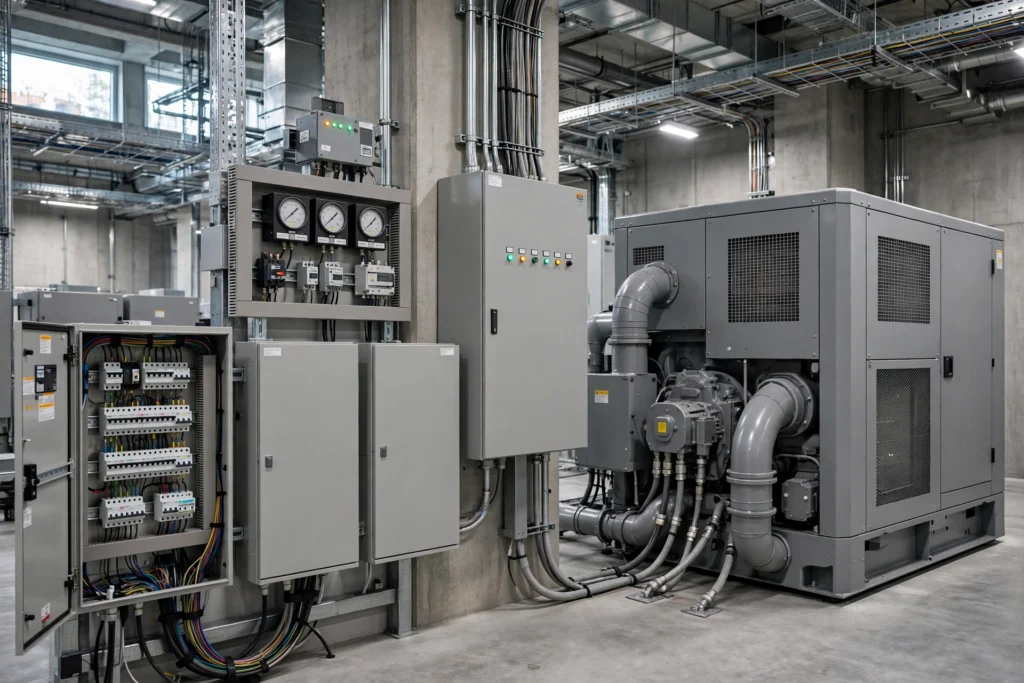
A reliable system is several parts working together:
- Power source. Usually an on-site generator, sized for the loads you need to keep running.
- Automatic transfer switch (ATS). Detects an outage, starts the source, and moves your building’s load over automatically, then returns it when utility power comes back.
- Distribution and wiring. Properly sized feeders, panels, and protection that route backup power to the right circuits.
- Critical load panels. Separate circuits for essentials, so backup power is directed where it matters most.
- Controls and monitoring. Alarms and status monitoring so problems show up before an outage does.
- Supporting systems. Short-term battery protection for sensitive equipment and emergency lighting, coordinated with the rest of the design.
Each of these has to match your building and your loads. An undersized system fails under demand, and an oversized one wastes money.
Who needs standby power
Standby power is worth considering for businesses where downtime is costly or risky, including:
- Warehouses and distribution centers
- Manufacturing and industrial facilities
- Cold storage and food-related operations
- Offices and data or telecom rooms
- Medical, dental, and care-related facilities
- Retail and service businesses that can’t close during outages
- Facilities with security, access control, or life-safety systems that must stay on
Standby power, emergency power, and UPS: what’s the difference?
These terms are often mixed up, and choosing the wrong one is a common mistake.
| System | What it does | Typical use |
|---|---|---|
| Standby power | Keeps selected operations running through longer outages | Production, refrigeration, HVAC, business continuity |
| Emergency power | Supports life-safety functions such as egress lighting and alarms | Code-required safety systems |
| UPS (battery backup) | Bridges the gap for seconds to minutes, with clean power | Servers, controls, and sensitive electronics |
Most businesses need a mix. A UPS keeps critical electronics running while the generator starts, and the standby system carries the building through a longer outage. We help you decide which loads go where. You can read more about our uninterruptible power systems and emergency lighting services.
How We Work With Your Business
1. Site survey and load review. We look at your building, your equipment, and what must stay running during an outage.
2. Load calculation and sizing. We calculate how much power you need and choose a system sized for your loads and future growth.
3. Design and code review. The design follows the National Electrical Code and applicable local requirements, with permits as needed.
4. Installation. We install the source, transfer switch, wiring, and controls, scheduling work to limit disruption to your operation.
5. Testing and commissioning. We test the system under load and confirm it transfers and returns correctly.
6. Training and handoff. Your team learns how the system operates and what to check.
7. Ongoing maintenance. Regular service and testing keep the system ready. See our preventive maintenance and thermal imaging services.
What affects the scope and cost of a standby power project
Every building is different, so we don’t quote a one-size price. The main factors are:
- How much of the building must be backed up, versus only critical loads
- The size and type of power source and fuel supply
- The condition and capacity of your existing electrical service and panels
- Where equipment can be located, and site access and conduit runs
- Permitting and inspection requirements
- Whether you need monitoring, battery backup, or lighting integration
We give you a clear scope and options after a site visit.
Why standby systems fail, and how we prevent it
Most failures come from preventable problems: untested systems, weak batteries, neglected transfer switches, undersized capacity, and poor maintenance. We design for your real loads, test under load at commissioning, and offer ongoing maintenance, so the system works the first time you need it.
Serving Wentzville and the surrounding area
We work with commercial and industrial customers in Wentzville and across Lincoln County, Warren County, O’Fallon, and St. Peters. If your business is in the region, we can visit, review your needs, and recommend a system that fits.
Frequently Asked Questions
What is a commercial standby power system?
It is a permanently installed backup system, usually with a generator and an automatic transfer switch, that powers selected parts of a building when utility power fails.
How is standby power different from a UPS?
A UPS uses batteries to cover short interruptions and protect sensitive electronics. A standby system runs longer, powering equipment, lighting, and building loads for as long as it has fuel.
Does the whole building need to be backed up?
Not always. Many businesses back up only critical loads, such as refrigeration, security, IT, key equipment, and lighting. That can lower the size and cost of the system.
How long does installation take?
It depends on system size, equipment availability, permits, and site conditions. We provide a timeline after the site survey.
Does a standby system need maintenance?
Yes. Regular inspection, testing, and service keep it reliable. Your equipment manufacturer, insurer, and local requirements may set specific schedules.
Do I need a permit?
Standby power installations generally require permits and inspections. We handle the process as part of the project.
Can you add standby power to an existing building?
Yes. We review your existing service and panels, then design the system around them, upgrading equipment where needed.
Protect your business from the next outage
If an outage would stop your operation, a standby power plan is worth discussing before it happens. Call 314-249-5563 or request a site visit to talk with Rolwes Electric about commercial standby power in Wentzville, MO.