
Commercial UPS Installation for Critical Equipment
A commercial UPS (uninterruptible power supply) is a battery-backed unit that sits between your power source and your equipment. When power drops, flickers, or surges, the UPS keeps supplying clean power for a short time. That gives equipment a chance to ride through the event or shut down safely, instead of crashing mid-task.
A UPS is not a generator. It buys minutes, not hours. Its job is to protect servers, controls, point-of-sale systems, and other sensitive equipment from the first few seconds and minutes of a power problem, and to bridge the gap until a generator starts.
Rolwes Electric handles commercial UPS installation for businesses and facilities around Wentzville and St. Charles County, as part of our broader commercial electrical services.
Why Short Outages Cause Long Problems
Most power events are brief, and that is exactly why they are easy to underestimate. A one-second dip can be enough to:
- Reboot a server or network switch and corrupt data being written
- Halt a production line or reset a controller mid-cycle
- Drop a phone system or point-of-sale terminals during business hours
- Shorten the life of electronics through repeated surges and sags
The cost is rarely the outage itself. It is the restart, the lost work, and the damaged equipment afterward.
Is a UPS Right for Your Facility?
A UPS makes sense when a brief loss of power costs more than the unit. Typical candidates include:
- Server rooms and network closets
- Security, access control, and camera systems
- Process controls and automation equipment
- Medical, lab, or testing equipment
- Point-of-sale and order-entry systems
- Equipment that is expensive to restart or recalibrate
If the equipment can lose power and restart without consequence, you probably do not need one. If it cannot, you do.
The Three Main Types of UPS
Type | How it works | Best suited for |
Standby (offline) | Runs on utility power and switches to battery when power fails | Small offices, basic equipment, lower-cost needs |
Line-interactive | Adjusts voltage sags and surges without using the battery, then switches to battery in an outage | Network equipment, small server rooms, general business use |
Double-conversion (online) | Constantly converts incoming power to DC and back to AC, so equipment always runs from conditioned power | Critical loads, data rooms, sensitive controls |
The higher the protection, the higher the cost and the more space, cooling, and maintenance the unit needs. The right choice depends on how sensitive your equipment is and how bad the consequences of a failure would be.
Electrical Support for Lincoln County Businesses
Sizing is where many installations go wrong. A unit that is too small overloads and fails when it is needed most. A unit that is far too large wastes money and space.
The basic approach:
➞ List the loads. Write down every device the UPS will protect and its power draw.
➞ Add them up. Convert to the same units, and pay attention to both watts and VA ratings on the equipment labels.
➞ Add headroom. Many installers leave a margin of roughly 20 to 30 percent for growth and to keep the unit from running at its limit.
➞ Decide on runtime. Ask what the UPS needs to do: carry the load for ten minutes, or just long enough for a generator to start and for equipment to shut down cleanly.
➞ Plan for the future. Equipment gets added over time, so confirm the unit can expand or that you have a plan for it.
A site visit is the surest way to get this right, because labels and assumptions do not always match what is actually plugged in.
What Installation Involves
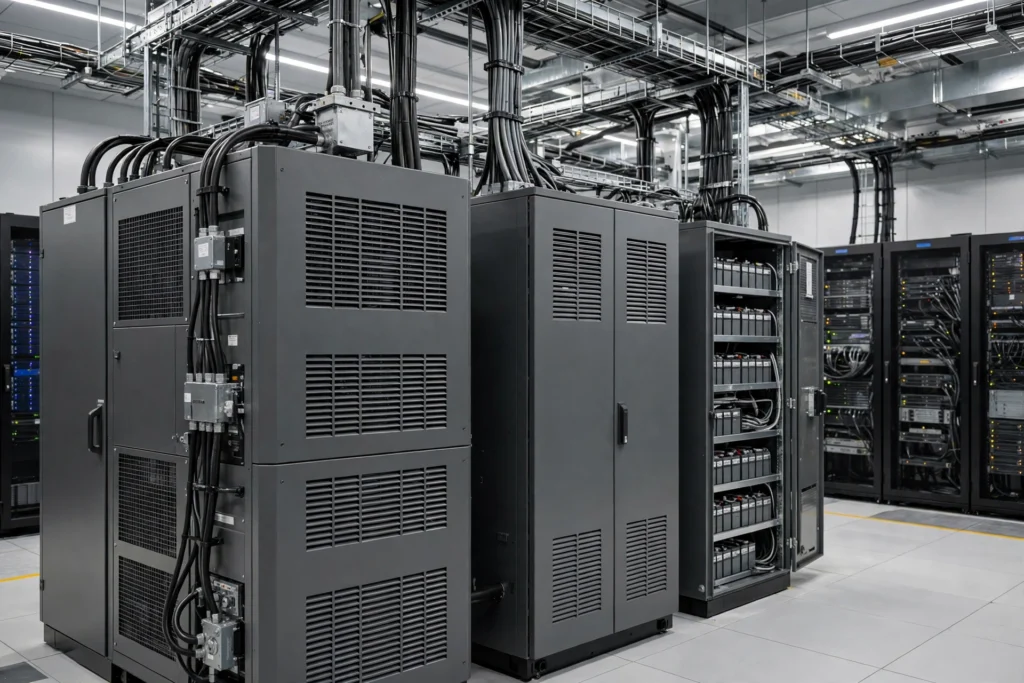
A proper commercial UPS installation is more than plugging in a box. The electrical side matters just as much as the unit.
- Dedicated circuit or feeder. Larger units usually need their own circuit sized and protected for the load.
- Space and ventilation. UPS units and batteries produce heat, and operating temperature affects battery life.
- Disconnects and bypass. A maintenance bypass lets the unit be serviced without cutting power to the load.
- Pairing with a generator. If you have standby power, the UPS, transfer switch, and generator need to work together without conflict.
- Labeling and documentation. Clear labeling of what the UPS feeds helps during maintenance and emergencies.
- Permits and inspections. Requirements depend on the project and your local authority.
Batteries Are the Part That Wears Out
The UPS itself can last many years, but the batteries are the weak point. Sealed lead-acid batteries commonly need replacement every three to five years, and heat shortens that. Lithium-ion batteries often last longer but cost more up front. Either way, a UPS with tired batteries can look fine and then fail the moment it is needed.
A simple maintenance routine helps:
- Check status indicators and alarms regularly
- Run periodic load or runtime tests
- Keep the area cool and the vents clear
- Track battery age and replace on schedule, not on failure
- Keep a log of tests and service
Common Mistakes We See
- Buying by price or brand without calculating the actual load
- Plugging high-draw equipment, such as heaters, into the UPS, which overloads it
- Installing it in a hot closet with no airflow
- Forgetting to account for expansion
- Skipping battery replacement until the unit fails in an outage
- Having no plan for what happens after the UPS runs out of battery
UPS Service Near Wentzville
Rolwes Electric is a commercial and industrial electrical contractor based in Wentzville, Missouri. We serve facilities across Warren County, Lincoln County, and St. Charles Counties, including O’Fallon and St. Peters, MO. Our team can review what you need to protect, recommend the right type and size of UPS, handle the electrical work, and help you set up a maintenance plan. If your facility also needs egress lighting that works during an outage, see our page on emergency lighting systems.
Frequently Asked Questions
What does a UPS do?
It supplies battery power to connected equipment when utility power fails or becomes unstable, giving equipment time to ride through the event or shut down safely.
How long will a UPS run during an outage?
Usually minutes, not hours. Runtime depends on the size of the unit, the battery capacity, and how much load is connected.
What is the difference between a UPS and a generator?
A UPS responds instantly but only for a short time. A generator can run much longer but takes time to start. Many facilities use both, with the UPS covering the gap until the generator takes over.
How often do UPS batteries need replacing?
Sealed lead-acid batteries commonly last about three to five years, depending on temperature and use. Lithium-ion batteries often last longer. Follow the manufacturer’s guidance and test regularly.
Can I plug anything into a UPS?
No. UPS units are meant for sensitive electronics. Equipment with heavy startup loads, such as motors and heaters, can overload them, so confirm what is appropriate before connecting it.
Do I need a UPS if I already have a surge protector?
A surge protector helps with spikes but does not keep equipment running when power is lost. A UPS does both, depending on the type.
Do you install UPS systems in existing buildings?
Yes. Many installations are added to existing server rooms, offices, and facilities without major construction.